

johndoe@gmail.com

by R. Darren Gobert
Professor of Theater Studies, Duke University
Please note that you will only be able to access content that your institution is subscribed to below.
Learn more about the career and plays of Caryl Churchill through this new essay by R. Darren Gobert. Subscribers can read selected scenes from each of the 5 plays featured below, as well as the chapter, ‘Churchill’s Landscapes’ from The Theatre of Caryl Churchill.
The American playwright Tony Kushner once called Caryl Churchill (born 1938) the world’s ‘greatest living English-language playwright’1. A writer of astonishing range and productivity, she had her first script produced while still a student at Oxford (Downstairs, 1958) and her first professional broadcast on BBC Radio 3 when she was only 24 (The Ants, 1962). A series of BBC radio plays and the birth of her three children preceded her first professional stage production: Owners, first staged at London’s Royal Court’s Theatre in 1972. But it was Cloud Nine, first produced in 1979, that thrust Churchill onto the world stage and secured the reputation she still enjoys: as a daring theatrical innovator whose experiments have pushed the form further than any English-language dramatist since Samuel Beckett.

Cloud Nine was written for the theatre company Joint Stock, whose actors explored questions of sexual politics, as well as their own sexual identities, during a three-week workshop of research and improvisations guided by director Max Stafford-Clark, a key Churchill collaborator since 1976. Churchill participated, then retreated to write a script structured on an audacious time jump. The first half unfolds in late nineteenth-century Africa, where a colonial administrator, Clive, colonises the indigenous population while disciplining his wife (Betty), son (Edward), and daughter (Victoria) into proper Victorian social roles. The second half is set in 1979, at which time the characters have aged only 25 years. The conceit embodies the play’s central idea: that sexual liberation proceeds slowly. Behaviours – especially gendered behaviours – that seem fully ‘natural’ are in fact learned over generations and reinforce toxic sexual politics in ways we may not realise. Churchill therefore renders the seemingly ‘natural’ vividly unnatural with various theatrical techniques, notably by doubling (that is, actors play multiple roles), by having actors switch roles between acts, and by casting across gender. For example, Betty is played by a man in Act 1 (since ‘what men want is what I want to be’), and Edward, whose effeminacy Clive strives to eradicate, is played by a woman. This cross-gender casting, meanwhile, visually renders straight relationships gay, and vice-versa, and thus underscores another theme. For the destabilising force of desire courses through the play, especially in Act 2 when the characters (whom Churchill says ‘change a little for the better’) can express themselves more freely despite their Victorian cultural baggage.

Churchill’s experiments with doubling found even more potent expression in her best-known play, Top Girls, which Stafford-Clark directed for the Royal Court in 1982. The play tells the story of Marlene, a businesswoman in London whose success depends not only on her intelligence and ruthlessness but also on the working-class sister, Joyce, who has raised Marlene’s child, Angie. As Churchill dramatises Marlene’s personal and professional relationships, she offers scenes out of chronological order so that Marlene’s present-day work success is overshadowed by her fractious family situation: the last word, Angie’s, is ‘Frightening’. Most radically, Churchill begins the play with a raucous dinner party attended by Marlene and a host of exceptional women: they range from the historical Lady Nijo, the thirteenth-century memoirist, to the legendary Pope Joan, who lived as a man, and to the fictional Griselda, the docile wife celebrated in literature since Petrarch. Played by the same actors who will play Marlene’s colleagues and family, the women talk mostly over one another – using a style of overlapping dialogue, coordinated with slashes (/) that Churchill pioneered. They tell as well as show how radically their successes have been limited by their social conditions, as well how often they’ve stood on the backs and not shoulders of the women around and before them. Even as Churchill marks her suspicion of individual achievement, then – like that of Margaret Thatcher, whose presence hovers – the dazzling, now-iconic theatricality of Top Girls testifies to Churchill’s own.

Equally daring and even more aesthetically maximalist was the playwright’s 1987 play Serious Money, again directed by Stafford-Clark for the Royal Court. The play, written after a workshop involving bankers in London’s financial district, concerns the world of high finance. The child of a monied stock broker, Scilla Todd (a London options trader) investigates the death of her brother (who had been selling insider information in support of hostile corporate takeovers). As she does, she discovers and covets the ‘serious money’ he has made and insinuates herself into his shady circle of global financiers. Churchill rapidly juxtaposes scenes from different settings, beginning with an excerpt from Thomas Shadwell’s 1692 play The Volunteers, or, The Stockjobbers. Thus she situates Serious Money in the tradition of ‘City Comedy’ (her subtitle) – which began contemporaneously with London’s first stock market, opened by Elizabeth I – as she traces a line from early stockjobbers to traders under Thatcher, who had radically deregulated the London Stock Exchange. Written mostly in doggerel verse and with up to five characters speaking at once, Serious Money mimics the market—all noise, all the time, from Tokyo to New York. And Churchill’s accelerating theatricality leaves its audiences stupefied but thrilled: in the rousing sung finale, the bankers correctly anticipate Thatcher’s 1987 re-election. Perhaps ironically the play remains her biggest commercial success. The Royal Court production transferred to the West End, then New York’s Public Theater, and then (in a first for Churchill) Broadway.

Like much of her work, Serious Money uses multiple settings and large casts as it examines the social and political forces that shape individual characters and stories. In that sense, A Number represents a departure, focused as it is on existential questions of individual identity. ‘The scene is the same throughout, it’s where Salter lives’ is all Churchill offers by way of context or stage directions. Over five elliptical scenes, Salter presses and is pressed for answers by three of his sons, Bernard, Bernard, and Michael Black, each a clone of the same dead predecessor and all played by the same actor. Through these exchanges the audience learns the backstory and also to distinguish the two Bernards (each raised by Salter) from one another and each Bernard from the placid Michael (who was not). Churchill’s short, spare play precisely matches its thematic content to its form, which we might liken to DNA. Every actor who plays the clones – starting with Daniel Craig in the premiere at the Royal Court in 2002, directed by Stephen Daldry – stands to his three characters exactly as they stand to one another: a genetically identical person with an entirely different way of being forged by unique circumstances. So too is each production of A Number—which has been staged and revived repeatedly, all over the world – forged and nurtured by its own circumstances. It comes into being anew, differently, each time.

Ten years later Churchill premiered Love and Information, an even more radical experiment in dramatic DNA. The script comprises over one thousand lines or speeches, divided into eight sections (including one with ‘random’ and even ‘optional’ scenes). Thematic through-lines emerge. But with no character list, speech prefixes, or stage directions, the play awaits the work of an unusually free director and cast. Directing the premiere at the Royal Court in 2012, Churchill’s longtime collaborator James Macdonald divided the text among 58 scenes and 138 characters (played by 15 actors) of various races, genders, and sexual identities. His staging emphasised how context clues from the production and not the playwright (a baby pram in this scene, an office desk in that) provide dramatic coherence. And, more than with other plays, productions of Love and Information are shaped by the living bodies who perform Churchill’s textual information and lend embodied sense to a remarkably open text. Recent critiques of Churchill’s Cloud Nine find fault with its subordination of colonial politics to sexual politics, but in Love and Information Churchill writes her way beyond categories of racial or sexual difference altogether: since the play prescribes no characters, it cannot predetermine them. Likewise, after a career filled with temporal experiments, Churchill goes further with Love and Information. Allowing for variable scene order and optional scenes, she defies the traditional shape of dramatic stories. (Only the final vignette is dictated by the script. The last words are ‘Sea anemone.’)
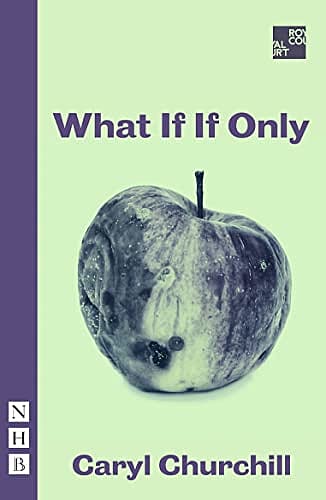
Even more than her earlier work, the play imagines an infinite future of theatrical meanings. And it offers the hope that directors and actors to come and technologies as yet unknown, inspired by Caryl Churchill, will continue to revolutionise stage practice. In this way Love and Information typifies the always future-looking direction that Churchill takes in her work, which now comprises over 50 published plays written over seven decades. Macdonald directed the first production of her most recent work, What If If Only, at the Royal Court in 2021.
Read Love and Information: Act 1
Subscribers may like to view the full playtexts of the plays featured above, as well as Churchill’s many other plays including What If If Only, Fen, The Skriker, Far Away, and Escaped Alone.


1Qtd in David Savran, ‘Tony Kushner considers the longstanding problems of virtue and happiness’, American Theatre, Vol. 11, No. 8 (Oct. 1994), pp.20-7, at p.24.


