

johndoe@gmail.com
 Facebook
Are you sure you want to reset the form?
Your mail has been sent successfully
Are you sure you want to remove the alert?
Your session is about to expire! You will be logged out in
Do you wish to stay logged in?
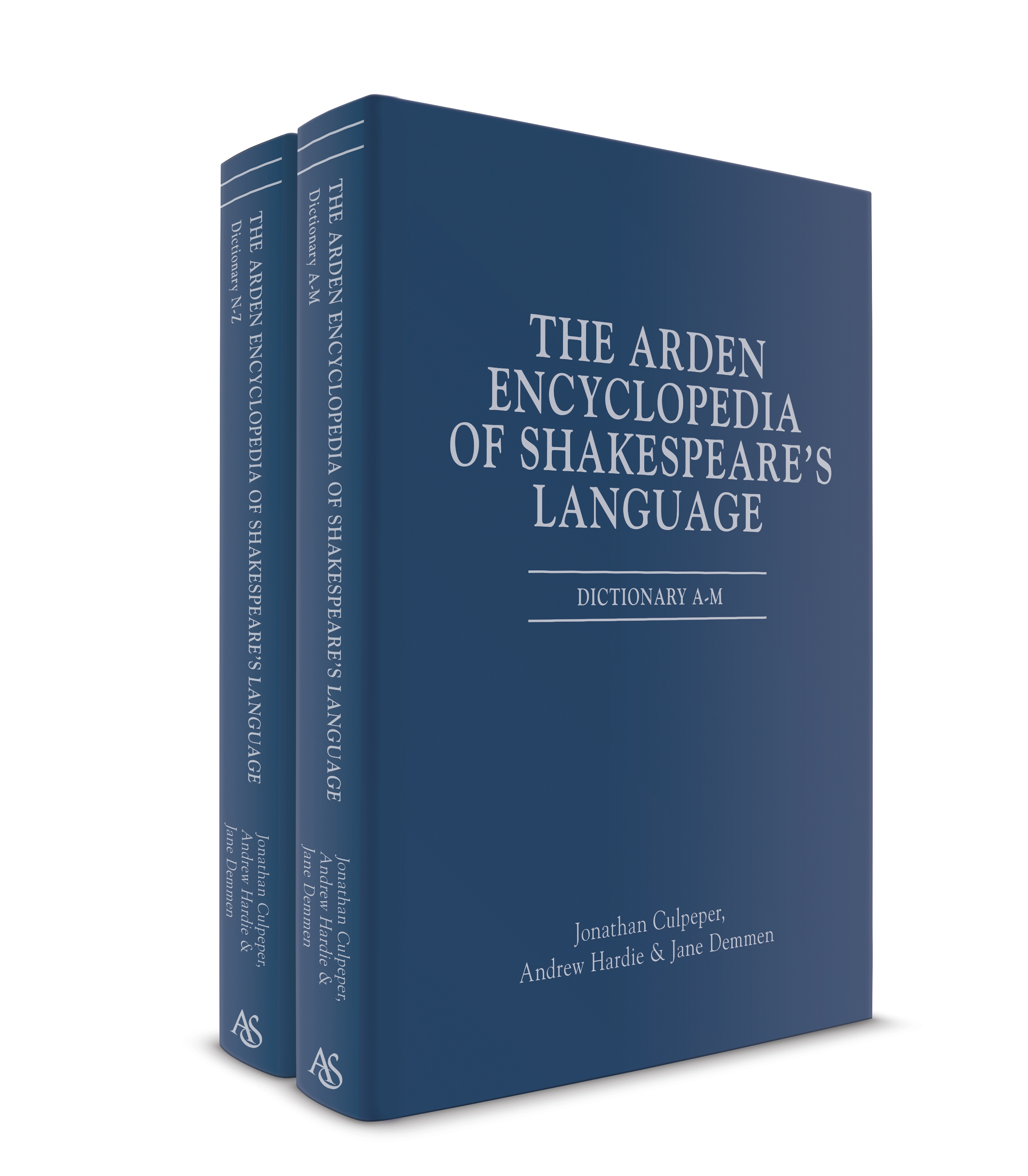
The Arden Encyclopedia of Shakespeare’s Language is the first comprehensive account of Shakespeare’s language to use computational methods derived from corpus linguistics – methods of choice for today’s lexicographer. A core part of the Encyclopedia comprises a non-etymological A-Z ‘dictionary’ that works through the frequency of word usage to reveal patterns of meaning and usage, and to examine what Shakespeare’s words actually do in the environments they inhabit. All words from all of Shakespeare’s plays are included – not just words judged to be ‘difficult’ – only leaving out proper names. The dictionary also covers words whose first known use is in Shakespeare (e.g. ear-piercing). Entries focus on the use and meanings of Shakespeare’s words, both in the context of what he wrote and in the context in which he wrote. Every word is compared with a 321 million word corpus comprising the work of Shakespeare’s contemporaries. Internal comparisons reveal how Shakespeare’s language varies dynamically across his works, showing, for example, whether certain words are peculiar to tragedies, comedies or histories, or to certain social groups, and whether they have a particular stylistic flavour.
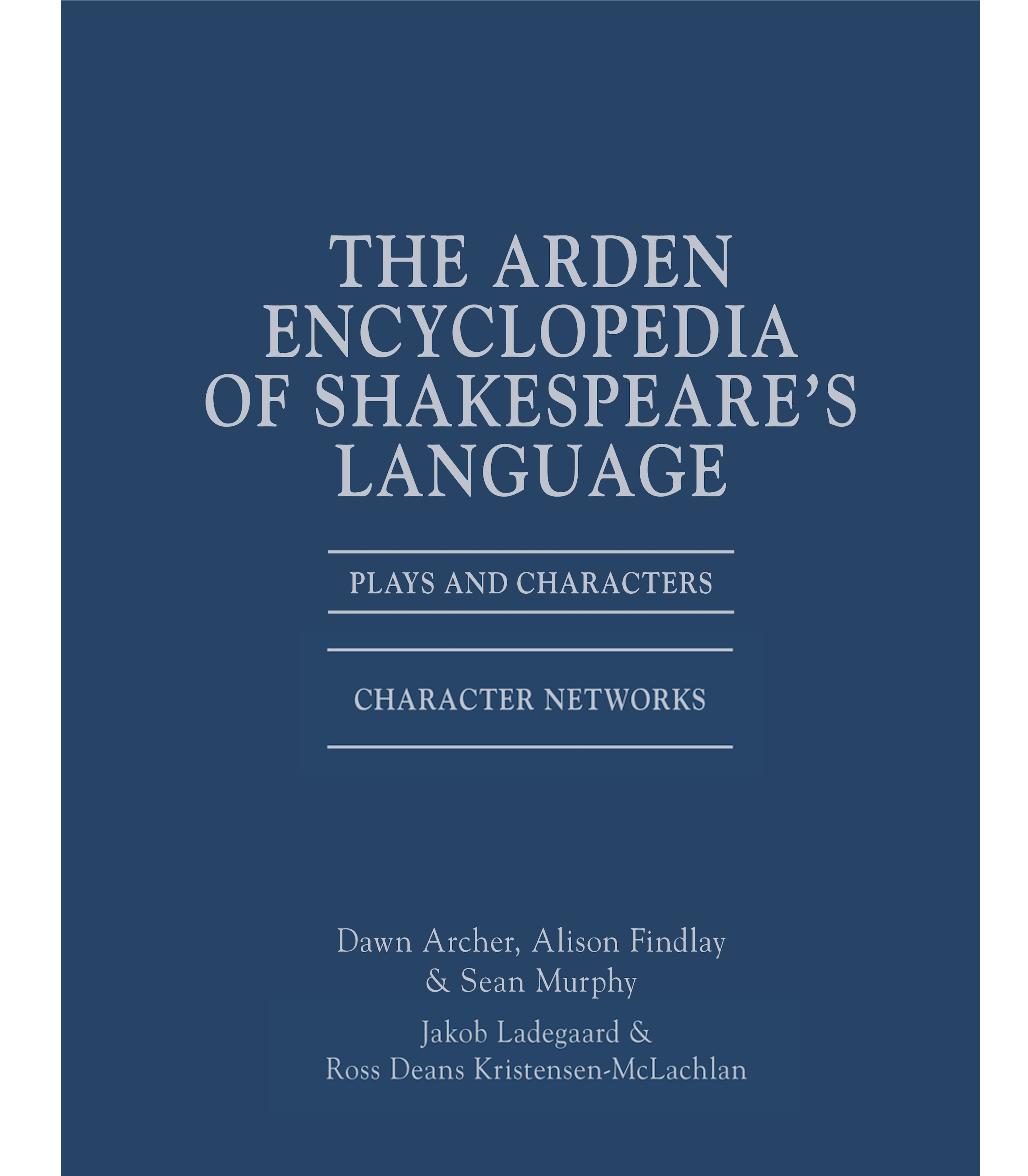
The Arden Encyclopedia of Shakespeare’s Language is the first comprehensive account of Shakespeare’s language to use computational methods derived from corpus linguistics – methods of choice for today’s historical linguist.
Volume 3: Plays and Characters focuses on keywords in Shakespeare’s plays. Play keywords are derived by conducting a statistical comparison between the words in one play with those in all the other plays. For characters, the statistical comparison is made between the vocabulary of one character and that of all the other characters in the same play. These keywords are then used to create ‘linguistic profiles’ of each play and main character.
Volume 4: Character Networks presents another aspect of what Shakespeare’s words do: create social worlds. For each of Shakespeare’s plays, the book includes information about the size and density of each play’s character network as well as providing a visual network representation. Readers will also find a table for each play with scores that measure the centrality of all characters in terms of the importance, strength and number of their social ties.

The Decades of Modern American Drama series provides a comprehensive survey and study of the theatre produced in each decade from the 1930s to 2009 in eight volumes. Each volume equips readers with a detailed understanding of the context from which work emerged: an introduction considers life in the decade with a focus on domestic life and conditions, social changes, culture, media, technology, industry and political events; while a chapter on the theatre of the decade offers a wide-ranging and thorough survey of theatres, companies, dramatists, new movements and developments in response to the economic and political conditions of the day. The work of the four most prominent playwrights from the decade receives in-depth analysis and re-evaluation by a team of experts, together with commentary on their subsequent work and legacy. A final section brings together original documents such as interviews with the playwrights and with directors, drafts of play scenes, and other previously unpublished material.

The Great European Stage Directors offers an authoritative account of the work, lineage and legacy of the major theatre directors from the late nineteenth to the end of the twentieth centuries. These volumes provide a uniquely rich study of the genealogy and development of a practice through focus on individual directors and the wider context and artform in which they worked. For professional practitioners and those developing their skills, as well as those engaged in the analysis of theatre practices, forms and history, it will prove an essential resource.
Each volume provides substantial treatment of three major directors, with each director considered by two specialists, combining analysis of the director's practical craft with accounts of the historical, cultural and theoretical context of their practice. Links between the featured directors and other artists and directors from the period are traced to round out the picture of influences and artistic development.

The Great North American Stage Directors provides an authoritative account of the work, lineage and legacy of the major theatre directors, where the role of the director is seen primarily as interpreter.
These volumes provide a uniquely rich study of the genealogy and development of a practice through focus on individual directors and the wider context and artform in which they worked. For professional practitioners and those developing their skills, as well as those engaged in the analysis of theatre practices, forms and history, it will prove an essential resource.
Each volume provides substantial treatment of three major directors, with each director considered by two specialists, combining analysis of the director's practical craft with accounts of the historical, cultural and theoretical context of their practice. Links between the featured directors and other artists and directors from the period are traced to round out the picture of influences and artistic development.

Bringing together 70 major critical articles across four volumes, Modern and Contemporary World Drama: Critical and Primary Sources collects scholarly articles, reviews and critical interventions that are indispensable to anyone wishing to gain an understanding of world drama from the past 150 years.
Contesting a Eurocentric reading or history of modern drama, the articles underscore the importance of migration and transnational movements of dramatic forms, and place emphasis on the transmission and circulation of dramatic theories around the world. Modern drama is revealed as a worldwide phenomenon in which a diverse array of artists and writers participated and in which modernism is seen to have affected all parts of the world in ways that are much more complex and multi-directional than what has been assumed in Eurocentric models.
The four volumes are arranged both thematically and chronologically to give readers a sense of how world modern and contemporary drama began and how it has been studied in the past 150 years.

Theories of Performance: Critical and Primary Sources offers a comprehensive collection of key writings on a subject which has come to permeate fields as diverse as theatre, comparative literature, philosophy, law, history, English, and science and technology studies, in what has been termed the transdisciplinary 'performative turn'. The collected essays draw upon writing from these diverse disciplines - and more - together illustrating how performance has become an ever more vibrant and plastic discursive practice. It includes a wide range of historical and more contemporary perspectives from the northern and southern hemispheres, with writing drawn from South and Southeast Asia, East Asia, Europe, Russia and the post-Soviet context, the Americas, Africa and the Caribbean. Expansive in their representation, the four volumes address current questions of protest culture, race and gender politics, biopolitics, indigenous studies and perspectives, postcolonialism and decoloniality, and language/translation, among others.
Each volume is introduced by the editor and arranged thematically, so that the development of ideas can be traced within a theme. The set includes 90 essays covering the following major areas: discipline, method, documentation, and body politic.


